


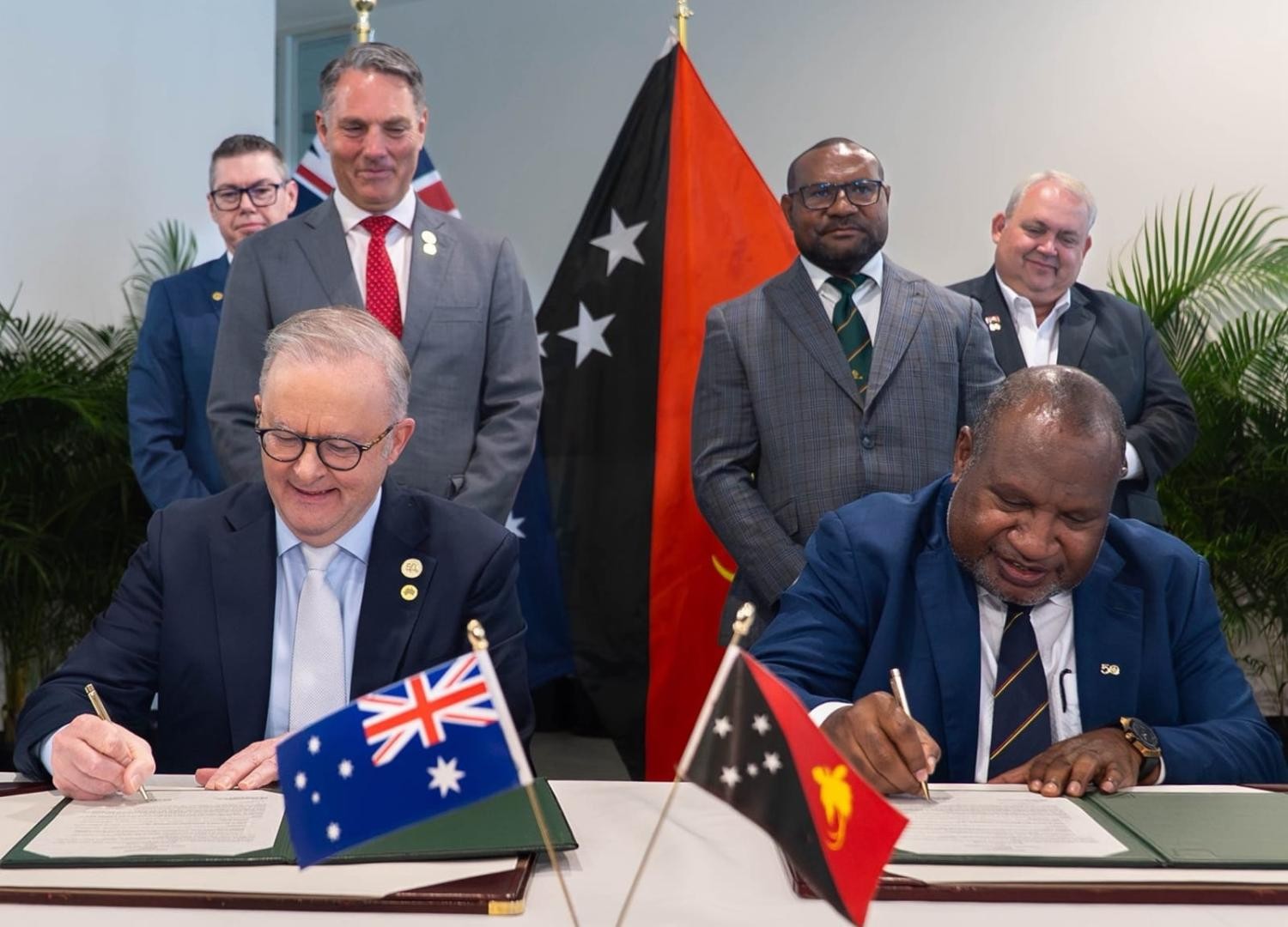
The Pukpuk Treaty between Australia and Papua New Guinea was officially signed on October 2, 2025, marking the newest Australian alliance since the 1951 ANZUS treaty with New Zealand and the United States. While the mainstream media was quick to sell this treaty as an alliance to balance Chinese intervention in the region, I believe they overlooked key historical context that would have provided a more nuanced perspective on the treaty's significance for both Australia and Papua New Guinea.
Why this matters to Australia?
Taking the prospect of PNG establishing stronger ties with China off the table is clearly in Australia's national security interest. PNG, Australia's closest geographical neighbor, is located within the country's inner arc, making it critical for Australia to deter foreign military intervention. After all, towns in PNG such as Rabaul and Wewak were critical to the Japanese in the Southern Pacific theater of World War II, making them prime targets for Allied forces to contest.
Having a meaningful security relationship with Papua New Guinea is critical to attaining the aforementioned objective. China has a strong interest in pushing a wedge between Port Moresby and Canberra, gradually transforming it into a Chinese military and economic sphere. This is clear from China's state-owned firms' efforts to influence and court the PNG government for years in order to strengthen economic and security connections, as evidenced by proposed projects such as the Kikori port upgrade. The Pukpuk Treaty is evidence of Australia tangibly contributing to an anti-hegemonic coalition balancing China, by supporting not only US national interests but also the interests of South East Asian and Pacific partner nations, as well as, most importantly, its own national security interests.
Furthermore, a robust and durable bilateral treaty with PNG alleviates Australia's future dread of a recalcitrant Indonesia. As I discussed in my op-ed, "Indonesia: friend or foe? A realist's perspective on future relations with Australia's next-door neighbour in the twenty-first century," I posited that, while Indonesia was an important partner in China's balancing in the short term, by the mid to late century, their latent and subsequent military power could potentially threaten Australia. As Hugh White attests in his book How to Defend Australia, Indonesia has always acted as a potential shield or threat to Australia's security environment, and having a genuine alliance partner in Papua New Guinea, given its geography and proximity to Indonesia, is extremely beneficial to Australia if Indonesia chooses the uncooperative path.
Why this matters to Papua New Guinea?
Two words: Bougainville. Independence. Papua New Guinea, which was an Australian territory until 1975, has struggled with the island of Bougainville seeking independence issue since its inception as a country. Just two days after PNG declared independence from Australia, Bougainville island declared its own secession, establishing the "Republic of the North Solomons." Though never recognized by the UN, the choice of name indicated Bougainville's desire to eventually merge with the geographically closer Solomon Islands rather than remain tied to distant PNG.
Bougainville is abundant in copper and gold. Rio Tinto and the PNG government collaborated in the early 1970s to develop Panguna, the world's largest open-cut mine at the time. Despite the enormous wealth extracted, little was reinvested locally. Environmental devastation and economic marginalisation fueled simmering resentment, resulting in the rise of the Bougainville Revolutionary Army (BRA). The BRA fought a bloody civil war against the PNG Defence Force, with Australia providing significant training, weapons, and logistical support to PNG. The conflict lasted 12 years before the Autonomous Bougainville Government (ABG) was established in 2000 through a peace agreement. That agreement included a referendum on independence, which would take place within 20 years. That referendum occurred in 2019, and the outcome was decisive, with 98% of Bougainvilleans voting for independence. In 2021, PNG Prime Minister James Marape and Bougainville President Ishmael Toroama agreed on a timeline for full independence by 2027.
However, independence for Bougainville poses significant risks for PNG. If one province successfully secedes, it may encourage others to follow suit. For Port Moresby, keeping Australia involved is critical to improving its position ahead of 2027. PNG might perhaps portray Bougainville's effort as an insurgency rather than a genuine independence movement, convincing Australia that participation would not violate treaty duties and that Australian military backing is required to quiet the bloodshed.
Australia, too, has reasons to oppose Bougainvillean independence. An independent Bougainville would be able to select its own security and economic partners. Beijing has already shown an interest in reviving the Panguna mine, and whomever owns such a massive resource would have enormous power over the island's destiny. This is no longer the post-Cold War "unipolar moment," in which sovereignty, self-determination, and human rights were in vogue. Today, great-power politics defines the Pacific and will have a greater influence on Australian foreign policy.
Australia may have once championed Bougainville's peace and autonomy. However, in an era of resurgent realpolitik, with China's presence drawing ever closer to Australia's "inner arc," Canberra's calculations may change. As Bougainville's independence deadline approaches, PNG may be able to lock Australia into supporting its position if it plays its cards right.
The future will decide
The next two years will be critical in determining the extent to which this treaty applies, whether Australia is now in a post-liberal world order and considers realism and national interest to be more important values than the liberal values of human rights, democracy and sovereignty. For Papua New Guinea, a relationship with Australia is critical, both in terms of realpolitik with China and Indonesia, as well as domestic political security, with Bougainvillean independence on the horizon.